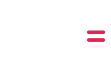
Comparing 3 schools side by side in USD.
Moosstrasse 106, 5020 Salzburg, Austria. Situated near the base of the Untersberg in the green suburbs of Salzburg, the campus is about ten minutes from the center. The setting offers Alpine scenery and access to Salzburg's cultural attractions.
7-12
Independent private international boarding school; primarily a full boarding school with day students.
Around 25 nationalities represented.
English language assistance program for non-native English speakers with four levels; after testing, students are placed in a level and mainstreamed into the regular program.
Non-denominational / non-sectarian.
Three trimesters run from September to May. Students receive about 36.5 hours of classroom instruction per week. Day students may remain on campus until 17:00 and can be dropped off in the morning or collected in the afternoon.
No school bus service; day students travel by public transport or are dropped off/picked up by family.
Boarding is provided on campus in school dormitories for full and five-day boarders. About 85% of AIS-Salzburg students are full or five-day boarders, and boarders reside on campus for approximately nine months each year. The resident-care staff consists of dorm parents and resident assistants who supervise boarders, with the dean of students coordinating the boarding program. Boarding students have curfew and lights-out times, and all full- and five-day boarders participate in weekend activities and evening study halls as part of the program.
The dress code does not include a uniform; students wear academic day attire in accordance with AIS-Salzburg's dress guidelines.
Dormitories serve as the living units with house staff on each floor; there is no separate, named school-wide house system described, and dorm parents plus resident assistants oversee housing duties.
The school is an independent private, non-denominational boarding-and-day school. It is accredited by the Middle States Association of Colleges and Secondary Schools and is a member of ECIS and The Association of Boarding Schools. The headmaster has overall authority over the academic and boarding programs, and the office manager sits on the governing body; the staff-to-student ratio is about 1:3.
AIS-Salzburg offers an American Curriculum for grades 1–12 with English as the language of instruction. In grades 11–12, the school also offers the International Baccalaureate Diploma Programme (IB DP). The school is Cognia-accredited and provides a broad Advanced Placement (AP) program, with full-credit and half-credit AP courses such as AP Calculus AB, AP Chemistry, AP European History, AP English Literature, AP German Language and Culture, AP Spanish Language and Culture, AP French Language and Culture, AP Italian Language and Culture, AP Environmental Science, AP Psychology, and AP Human Geography. Gifted and Talented Enrichment is available, including national competitions. The curriculum includes Arabic Language and Identity Studies and Islamic Studies for Muslim students, along with Physical Education and Social-Emotional Learning; university and career readiness starts in Grade 10 with a college counselor and on-campus university placement support. Standardized testing on campus includes MAP assessments and AP and SAT examinations to support university admissions and credentialing.
Teacher-to-student ratio is about 1:3.
Graduates matriculate to universities in North America, the United Kingdom, continental Europe, and elsewhere worldwide, with about one-third each going to North American universities, UK institutions, and European universities, respectively.
Gifted and Talented Enrichment is offered, including participation in national competitions.
AIS-Salzburg focuses on intellectual development as well as emotional, physical, and ethical development. The Mission and Beliefs describe Balance and Wholeness and emphasize a safe, respectful environment, individual guidance, and the development of character to prepare students for responsible citizenship.
The language of instruction is English. The school requires English proficiency for non-native speakers, with accepted tests including TOEFL, TOEFL Junior, Cambridge, IELTS and SLEP; AIS-Salzburg also offers its own English proficiency examination during a campus visit.
AIS-Salzburg prioritizes emotional development as part of its educational program. The Mission & Beliefs highlight Balance and Wholeness, including emotional development, while safeguarding provisions focus on health and well-being and providing support when needed. Staff training and a safe environment support students' mental wellbeing.
AIS-Salzburg has a Child Protection Policy and Procedures. Safeguarding is a daily duty implemented by all staff, with regular training and ongoing updates. The policy defines safeguarding, protection, and support and includes reporting procedures, investigations, and coordination with authorities as required. It applies to day students and boarders, including students aged 18 and older, on campus and during school activities. Parents and guardians are provided access to the full Child Protection Handbook; the policy aligns with the UN Convention on the Rights of the Child and Austrian laws.
Step 1: Download the Student Application Form and return it to AIS-Salzburg with an appropriate photo of the applicant. The Application Form can be filled out using the provided link. This initiates the admissions process in an orderly manner. Step 2: Submit up-to-date copies of transcripts from the present school with translation if necessary; for grades 7–9 only the previous year's transcripts are required, while grades 11–12 require records from all high school grades completed or currently enrolled. Step 3: Submit a copy of the applicant's passport photo page along with any currently-held visas for Austria or another Schengen nation. Step 4: Request that the applicant's current English and mathematics teachers submit a confidential recommendation to AIS-Salzburg. The teacher recommendations can be forwarded or downloaded. This helps inform the admission decision. Step 5: Pay the application fee (€150.00) by bank or online transfer to the AIS-Salzburg account. Upon reception, AIS-Salzburg will make a decision concerning enrollment or determine that further testing (English proficiency) and/or a personal or online interview with the applicant is required. If the applicant is accepted, a copy of the Enrollment Agreement and invoices for tuition and fees, the Capital Levy, and mandatory fees will be sent; parents of applicants have 30 days to consider the offer before it is revoked. AIS-Salzburg does not publish a hard application deadline, but visa-required enrollment may necessitate timely action (visa processing can take up to 90 days), and enrollment should be secured before the end of May for the following school year.
Scholarships and Financial Aid at AIS-Salzburg. The administration provides support for Ukrainian families displaced by the conflict. Further scholarship considerations are suspended until the conflict ends.
Zaunergasse 3, 5020 Salzburg, Austria. The address is on the Bundesgymnasium Zaunergasse campus.
Lower School (Years 1–4, ages 10–14): bilingual German and English. Upper School (Years 5–8, ages 15–19): English as the main language of instruction.
Public, state-funded Gymnasium.
Around 55 nationalities represented; about 50% German as a first language, 30% English as a first language, 20% other languages.
SALIS ARC provides academic and remedial coaching available to all SALIS pupils.
Austria.
Day-school; no boarding is provided.
SALIS is part of Bundesgymnasium Zaunergasse (BG Zaunergasse), a public Austrian state school.
SALIS offers the International Programme at Salzburg's first public international school, with instruction in English and German, and it hosts around 55 nationalities. From ages 10–14, teaching is delivered in both English and German, enabling international pupils to master German while local German-speaking children become fluent in English. In the upper-level grades (ages 15–18), English is the main language of instruction. Students can acquire two diplomas—the Austrian Matura and the IB Diploma. Teaching is delivered by German- and English-speaking staff, with some subjects taught by Austrian teachers supported by staff with English as a mother tongue, and SALIS ARC provides academic and remedial coaching free of charge.
Graduates gain access to universities worldwide through both the Austrian Matura and the IB Diploma.
Student well-being is a central pillar of SALIS, with enhanced personal development programmes focused on resilience, emotional intelligence, and digital citizenship to support learners emotionally and socially.
SALIS ARC offers Academic and Remedial Coaching, free of charge, open to all SALIS pupils, providing subject-specific guidance and skills development.
From ages 10–14, teaching is delivered in English and German; in upper levels (ages 15–18), English is the main language of instruction. The programme uses German- and English-speaking teachers, with some subjects taught by Austrian teachers supported by staff with English as a mother tongue.
The strategy prioritises student well-being with personal development programmes focused on resilience, emotional intelligence, and digital citizenship.
The SALIS admissions process consists of four steps: Registration, Assessment, Pupil Assessment Form (PAF), and Decision. The registration form is the first step and collects the applicant's biography and educational history; it requires scans of the passport, birth certificate, latest school reports, e-Card (if available), and Meldezettel. The deadline for Year 1 (grade 5) registration is typically just before Christmas in the year before admission; registrations for Years 2–8 (grades 6–12) may be considered until the end of May before the starting academic year. The 2025/26 Year 1 deadline was 12:00 on Friday 19 December 2025. Successful Year 1 candidates will engage in learning in at least one language of instruction: English or German; a German-speaking child is not required to have English beyond what is taught in primary school. After registration, admissions assessments are scheduled: Year 1 assessments typically take place in mid-January; Years 2–8 assessments occur about 3–6 months before the starting date. Year 1 assessments cover reading, language creativity, and logical thinking and are conducted in English or German; a fee of 60 EUR applies if sat after the scheduled January assessment. Years 2–5 assessments include written tests in Maths and English and are sat in English; in-house or distance assessments may be used; fees are 90 EUR per subject. Year 6 assessments include Maths, English, and one natural science; Year 7–8 (IBDP) include Maths, English, and one natural science; fees per subject are 90 EUR for Year 6 and 120 EUR per subject for Years 7–8. After assessments, the Pupil Assessment Form is issued for completion by the applicant's current school to provide further insight; Year 1 usually does not require a PAF. An invoice for the admissions assessment fee is sent and paid online. After these steps, a decision is made; applicants may be asked to submit a 350-word personal statement (for Years 6–8) and may be invited for an informal visit; meetings are by appointment. If a suitable candidate has no place in the appropriate class, the applicant is placed on a waiting list, and SALIS contacts the strongest candidates when a position becomes available. A decision is not made until all requested documents are received and any outstanding assessment fees are paid, except in extraordinary circumstances at SALIS's discretion. For Year 1 entry in September 2025, decisions were shared by the end of January 2025.
If a suitable candidate has no available place in the appropriate class, the applicant is placed on a waiting list, and SALIS contacts the strongest candidates when a position becomes available.
St. Gilgen International School is located in St. Gilgen, Austria, in the Salzkammergut Alpine region. The campus sits in an alpine village with year‑round outdoor opportunities and access to Salzburg, Vienna, and Munich cultural experiences. It is about 35 minutes from Salzburg Airport, with easy connections via Salzburg, Munich, and Vienna airports, and a dedicated school bus from Salzburg. The area features an UNESCO World Heritage region with 50 peaks, 67 lakes, and 300 km of ski slopes.
Primary Phase; Middle Phase; Senior Phase.
IB World School.
Nationalities represented: over 35.
Pastoral network provides personalised care through mentor tutors, houseparents, nurses and teachers. The Medical Center offers care with nurses and visiting therapists, including therapy and psychological support. Mentor Tutoring provides daily check‑ins and small group sessions to help students grow academically and personally.
Austria.
Dedicated school bus from Salzburg.
Boarding houses Bachwirt, Traube, and Kendler are minutes from campus. They offer en-suite, shared double rooms arranged by age and gender to provide comfort and community. A dedicated boarding team supports a safe, structured environment and the overall wellbeing of boarders.
All students are expected to wear the distinctive school uniform smartly and formally, upholding the school's ethos. The uniform reflects the high standards valued by StGIS.
Boarders have breakfast and dinner in boarding houses, while all students receive healthy lunches from local village eateries. Menus feature fresh, locally sourced Austrian and international dishes, with plenty of salads, vegetables, and fruit. Vegetarian and special dietary needs are fully accommodated.
Pupils are assigned to boarding houses Bachwirt, Traube, and Kendler, arranged by age and gender and located near campus. Mentor Tutors and Houseparents provide ongoing support within the house structure. The school offers an Activities Programme with events such as The Dare Adventure Race.
The school is owned by a parent-established foundation, St. Gilgen International School Privatstiftung, since May 17, 2016. Day-to-day operations are managed by St. Gilgen International School GmbH, a non-profit company. The Foundation provides strategic oversight, including governance, long-term planning, and Head of School appointments, with a Board Policy Manual detailing operations.
Curriculum is delivered in three phases: Primary Phase (Grade 5) focuses on English development with interdisciplinary study in English, German, World Studies, Science, Mathematics, The Arts, and Movement & Wellbeing; Primary culminates in a UN SDG–linked Primary Exhibition. Middle Phase (Grades 6–10) follows the IB Middle Years Programme (MYP), with enquiry-led learning and a Personal Project in Grade 10, based on a balanced eight-subject framework: Language & Literature (English and German), Language Acquisition (English, German, French, Spanish), Individuals & Societies, Science, Mathematics, Arts, Design, and Movement & Well-being. Senior Phase (Grades 11–12) offers the International Baccalaureate Diploma Programme (IBDP) alongside the StGIS Diploma, with CIS and WASC accreditation; the IBDP core includes the Extended Essay, Theory of Knowledge, and CAS, and students choose six subjects from the subject groups. Graduates have access to top universities worldwide, with destinations such as Harvard, Oxford, IE University, Paracelsus University Medical School, Bocconi, Groningen, LSE, King's College London, St Andrews, Imperial College, Stanford, and the University of Vienna, supported by university and careers guidance.
The IB Diploma Programme is scored out of 45 points. Our students consistently perform above the world average and gain entry to top universities.
Graduates go on to universities worldwide, with recent destinations including Harvard University (USA), University of Oxford (UK), IE University (Spain), Paracelsus University Medical School (Austria), Bocconi University (Italy), University of Groningen (Netherlands), LSE, King's College London, University of St Andrews, Imperial College London, Stanford University, and the University of Vienna; university and careers guidance supports each student's path, including help with entrance tests and applications.
The school supports social and emotional learning through a dedicated pastoral network of mentor tutors, houseparents, nurses, and teachers, providing personalised care supporting academic, social, and emotional growth. The Pastoral Web fosters belonging, respect, and responsibility. Flourishing Together, through the Summit programme, assemblies, and inquiry days, helps students develop emotional intelligence and resilience.
Beginner English language learners receive support in Primary and Middle Phases; from Grade 10 upward, strong English proficiency is expected.
The Medical Center provides high-quality care for physical, social, and mental wellbeing, with therapy and psychological support available from visiting specialists twice monthly. Our medical staff works closely with Boarding House Teams and the Student Support Team to ensure comprehensive care for every student.
The school has a safeguarding framework and a Child Protection Policy; a dedicated pastoral team—Mentor Tutors, Residential staff, Nurses, and the School Counsellor—provides care and protection to students and fosters a safe environment.
Stage 1: Written application. Submit a completed application form, school reports from the last three years translated into English and certified if required, a copy of the student's passport, a motivation letter, a recommendation from the current school, and copies of relevant certificates, along with the €290 application fee. All application documents must be submitted in English; rolling admissions are available and placement is typically age-based with flexibility when appropriate. Beginner English language learners receive support in Primary and Middle Phases; from Grade 10 upward, strong English proficiency is expected.
Stage 2: Arrange a visit. The Trial Day lets you explore a typical day at StGIS and includes an interview with the Head of School, a guided campus tour, placement tests in English and Mathematics, and attendance in regular classes; boarding applicants may overnight in the boarding house. Primary Trial Days can be arranged on most days, with a dedicated Primary Open Day recommended.
Stage 3: Contractual documents. Tuition invoices are issued in line with the agreed start date and must be paid in full before the student begins. To complete enrollment provide a signed school contract and Power of Attorney; proof of tuition payment; a valid health insurance policy in Austria; a copy of the passport; birth certificate translated into English or German; photographs in accordance with EU passport photo guidelines. A full copy of the Admissions and Fee Policy is available upon request or after submitting a completed application.
Show us your best. St Gilgen International School offers a generous scholarship program for exceptional students. Most scholarships granted are partial; full scholarships are extremely rare and awarded only for truly exceptional applicants. Scholarships are reviewed annually by the Head of School; Applications must be submitted no later than mid-March; Scholarships can only be awarded upon first entry to the school, or in cases of an extreme change in circumstances.